Short answer first. Yes, DCA is good in a sideways market, and for most accumulators the right move is to change nothing. A bitcoin sideways market DCA plan does its quiet work exactly when the chart looks boring: your fixed weekly buy keeps purchasing at every point inside the range, so your average cost settles near the middle of that range without you timing anything. Pause only if your income or cash buffer changed, not because the price is dull. Treat forecasts, including range distributions, as background reading, never as the trigger for a buy.
What a sideways market actually is
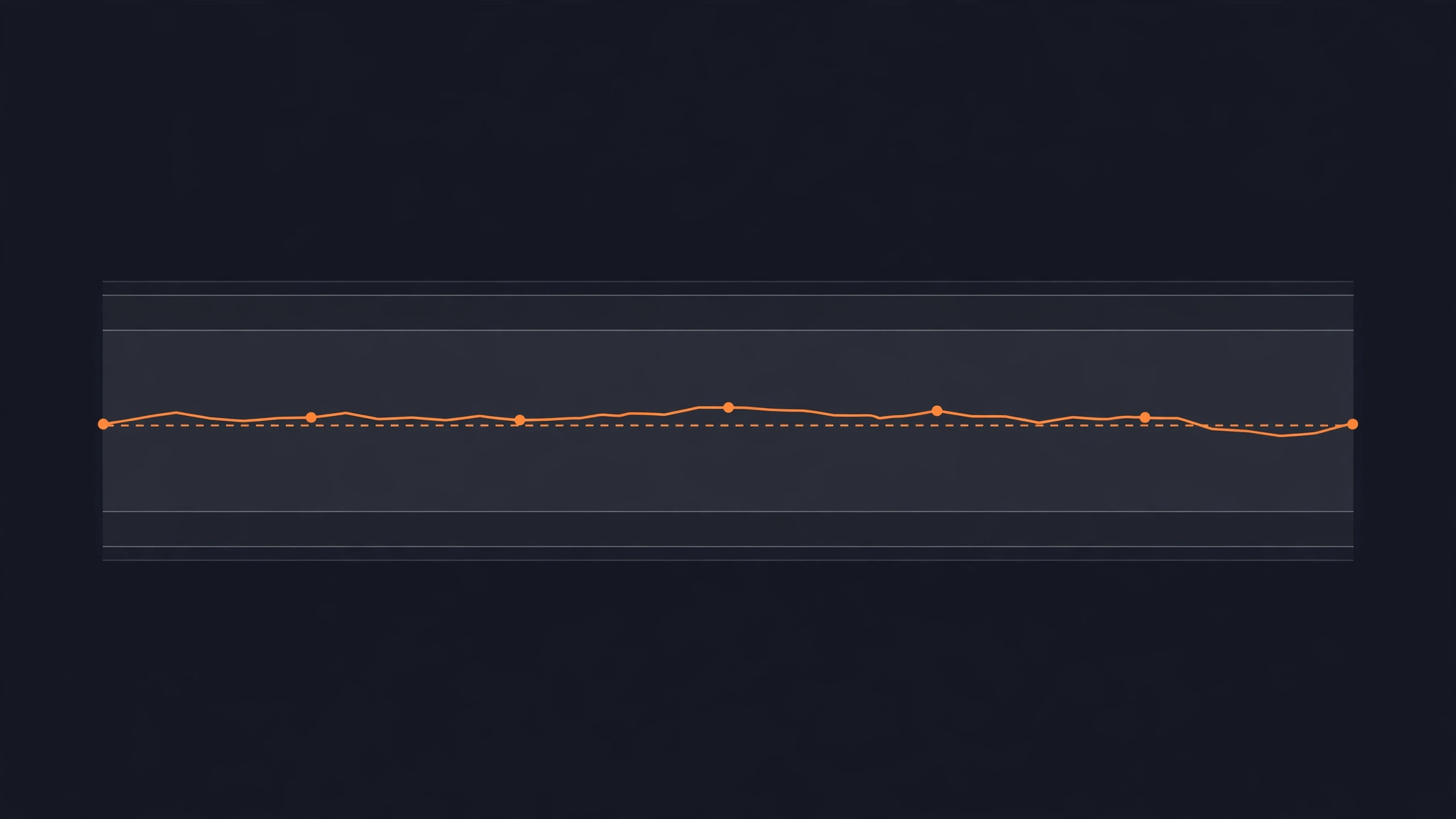
A sideways, or range-bound, market is a stretch where Bitcoin trades between a fairly clear floor and ceiling instead of trending. It can last weeks or months. Bitcoin has spent long stretches of 2026 doing this: rallies that stall, dips that get bought, and a price that ends the month near where it started.
For a trader, that is frustrating: there is no direction to ride. For an accumulator, a range is not dead time. It is a series of buys at roughly the same prices, and repetition at stable prices is the raw material a DCA plan is built from. If you are new to the mechanics, our guide to how DCA works covers the basics before the sideways case below.
Why boring markets suit a fixed buying plan
DCA has one structural quirk that matters most inside a range: a fixed cash amount buys more bitcoin at the bottom of the range than at the top. It happens automatically, and it pulls your average cost toward the lower half of the range over time.
Here is the arithmetic, with invented prices for illustration only: not a backtest, not a promise. Say Bitcoin ranges between $60,000 and $66,000 for a month, and you buy $100 each week at four different points inside that range:
- Week 1 at $60,000: you receive about ₿0.00167
- Week 2 at $66,000: you receive about ₿0.00152
- Week 3 at $61,000: you receive about ₿0.00164
- Week 4 at $65,000: you receive about ₿0.00154
After four buys you hold about ₿0.00636 for $400, an average cost of roughly $62,900 per bitcoin. The midpoint of the range is $63,000. Your average landed just under it, because the cheaper weeks handed you more sats per dollar. Stretch that behaviour across a long range and the effect compounds quietly: no prediction, no timing, just the shape of fixed buys inside a band. You can run the same arithmetic on your own amounts with the DCA calculator.
Bitcoin sideways market DCA compared with trending and crashing markets
A range is only one of three environments your plan will meet. The same weekly buy behaves differently in each:
| Market type | What price does | What your DCA buys do | The main risk to your plan |
|---|---|---|---|
| Sideways (range-bound) | Moves between a floor and a ceiling for weeks or months | Average cost settles near the range midpoint; units accumulate steadily | Boredom. Stopping the plan because nothing seems to happen |
| Trending up | Climbs with shallow pullbacks | You keep buying at higher prices; average cost rises but stays below the latest price | FOMO. Abandoning the schedule to chase with a lump sum |
| Crashing (sharp downtrend) | Falls fast, often in steps | Each buy is cheaper than the last; average cost falls quickly | Fear. Pausing buys at exactly the prices the plan exists to catch |
Read the table from the plan’s point of view, not the chart’s: the sideways row is the only one where the main threat is psychological rather than financial. Our piece on how long a DCA plan can stay underwater covers the crash case in depth.
Reading a price-range distribution: one input, never a trigger
Traders who live in sideways markets think in ranges rather than directions: the useful question is not “up or down” but “inside which band, and how likely is each band”. Prediction markets built on ranges make that view visible.
On Glimpse, a prediction market that prices numbers instead of yes or no events, each market splits a future price into ranges, covering Bitcoin hourly and daily, gold, hashprice and mining difficulty. Every range carries a price, and that price is its implied probability: a range priced at 30 is the crowd saying roughly a 30 percent chance. Contracts pay 100 sats to whichever range wins, and everything settles in Bitcoin over Lightning.
How should an accumulator read that distribution? Three honest uses, and one hard limit:
- Width tells you about agreement. If most probability sits in two or three neighbouring ranges, the crowd expects the range to hold. If probability smears thinly across many ranges, nobody is confident that it will.
- Shape tells you about skew. A distribution leaning below the current price means the crowd is paying more for downside ranges: information about mood, not a forecast you can bank on.
- Change over time tells you about drift. A distribution that narrows week after week describes a market settling into its range. One that widens describes growing uncertainty.
The hard limit: none of this tells you whether to buy this week. The distribution is other people’s probabilities, with fees and sentiment mixed in, and it can be wrong in both directions. It should never decide whether the buy happens, because the moment a forecast becomes your trigger, you are no longer running a DCA plan. You are timing the market with extra steps.
Bitcoin sideways market DCA: hold, pause, or size the buy?
When the chart goes flat for months, three options present themselves. Here is a plain way to judge each.
Hold (the default). Keep the amount, keep the day, keep buying. In a range, holding is not passive neglect; it is the strategy working as designed, harvesting the small arithmetic edge shown above.
Pause (rarely, and only for life reasons). Pausing makes sense when your income drops, your emergency fund needs rebuilding, or the money is genuinely needed elsewhere. It does not make sense because the price has been boring, or because a forecast suggests the range might break down next month. If ranges reliably predicted their own endings, they would not be ranges. Cadence is a separate question: our comparison of daily vs weekly DCA shows what changes and what does not.
Size slightly (only inside a written rule). Some accumulators pre-commit to a modest tilt, for example buying their normal amount mid-range and a fixed step more when price sits in the lowest quarter of an established range. That can be reasonable, but only if the rule was written down before the range started, the step is small, and the total monthly spend stays within your budget. If the sizing decision requires checking a forecast, a chart, or your feelings on the day, it is not a rule. It is discretion wearing a rule’s clothes.
FAQ
Is DCA good in a sideways market?
Yes. A sideways market is arguably the friendliest environment for DCA, because fixed buys purchase more bitcoin near the bottom of the range than near the top, pulling your average cost toward the lower half of the range over time. The catch is purely psychological: progress shows up in units stacked, not in price excitement.
Should I pause my DCA when Bitcoin goes sideways?
Not because of the price action. Pause if your income or cash reserves changed and the money is needed elsewhere. Pausing because the chart is dull usually means restarting later at whatever price ended the range, which converts a no-timing plan into a badly timed one.
How long can a Bitcoin sideways market last?
Weeks is normal, and several months happens in most cycles. There is no reliable way to know a range’s end date in advance, which is precisely why a schedule-based plan fits ranges so well: it does not need the end date to work.
Can a prediction market range tell me when to buy?
No. A range distribution shows how a crowd is pricing probabilities right now, and how confident that crowd is. It cannot tell you next week’s price, and using it as a buy trigger replaces your plan with someone else’s guess. Read it for context. Buy on schedule.
The quiet conclusion
Sideways markets are where DCA plans are won or lost, and they are almost never lost on arithmetic. They are lost when a bored holder stops buying, starts trading the range, or hands the schedule over to a forecast. Keep the buy fixed, let the range do its slow work on your average cost, and let other people’s probabilities stay what they are: interesting, occasionally useful, and never in charge. Every good sideways-market decision is made once, in advance. Every bad one is made weekly, at the screen, in response to boredom.